Standard analytical tools are sufficient for many problems. When the behaviour of a complex system depends on interactions among many components, however, the appropriate representation and analysis method may need to be developed specifically for the application.
We can bring our experience in experimental data analysis, statistical inference, simulation, machine learning, and complex-system modelling to situations where an off-the-shelf analytical approach is inadequate. The objective is not to apply a preferred method, but to identify or co-develop the representation and tools that best fit the available data, the structure of the system, its uncertainties, and the decisions to be supported.
ASTRAEA is a current example of this approach. For the specific problem of increasingly autonomous space traffic, together with Chelonia and ETHZ, we are investigating a novel approach based on Graph Vector Field (GVF) methods to represent the global configuration of interacting objects and support risk assessment and decision-making. This work brings ongoing research into a concrete application, illustrating how purpose-developed methods can address problems for which established approaches may be insufficient. The same problem-driven philosophy can be applied to other distributed and networked systems.
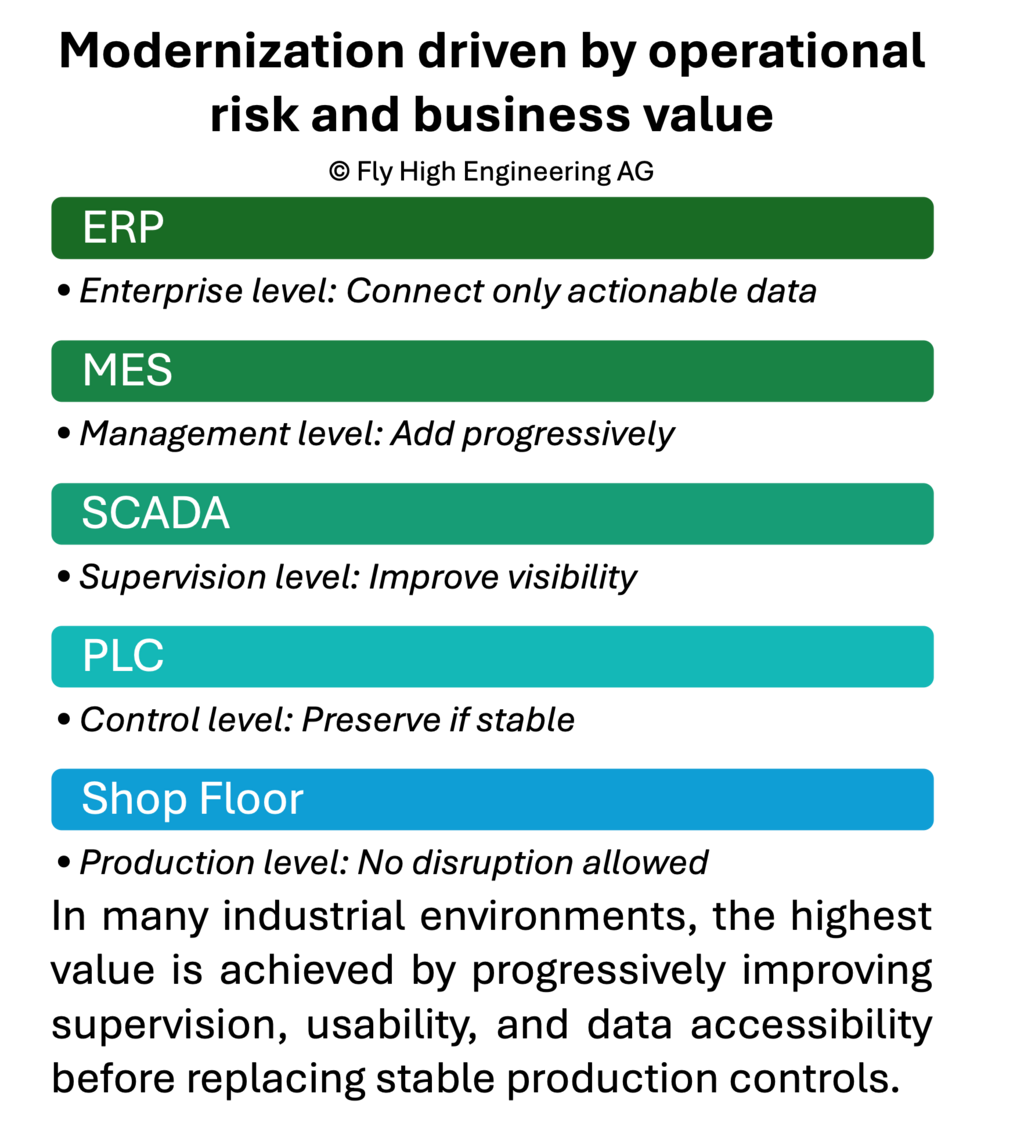
We review your business model and the processes followed by your organization, to identify a prioritized list of interventions, which are the simplest modifications of the existing systems that produce measurable business value.
Before implementing them, to minimize adoption resistance, we ensure that change management is properly considered.
Two examples are mentioned below.
Very often, production equipment works reliably but is obsolete and isolated from the ERP/MES. To integrate it within a modern IT infrastructure, we focus on the minimal amount of actionable information that your business needs to achieve real-time monitoring of production processes and enable timely countermeasures in case of issues. The next step is to load “recipes” for each production batch directly from the MES, which eliminates costly mistakes. Further improvements may be applied later, e.g. to enable predictive maintenance and/or logistics.
When the experts leave the organization, it is difficult to find young personnel at ease with obsolete HMIs, built by experts for experts. We consider the HMI an essential component, both because it provides personnel with the means to control production and because it may be used in smart ways to add functionalities on top of obsolete equipment. We design it by keeping the latter in mind, while adopting an intuitive navigation-based style that allows the operator to work in a lean and effective way.
For executives it is typically difficult to identify the best technology and architecture that allow them to achieve their strategic goals. Our sound technical background and experience in general management offer solid pillars for business-driven technological choices that are aligned with the organization’s strategy.
The assessment of the current situation is a necessary step before any technical intervention is performed on critical equipment. This includes a gap analysis to clarify what is missing with respect to an ideal case, and a risk analysis to identify what can possibly go wrong and its impact. It also involves the definition of relative priorities for different possible changes, which are correlated to budget and time constraints to obtain the best roadmap for the technical work.
Sometimes things go wrong and nobody is able to revert back to a stable situation. This happens most often when equipment is very old, several patchy modifications have been applied over time by different experts, and none of them is available any more to help. In extreme cases, we have to do reverse engineering of control systems just to answer simple questions, because nobody took care of writing good documentation while “evolving” the system. Appropriate knowledge management is essential for the success of long-living equipment, and we always ensure that architecture and changes are properly documented.
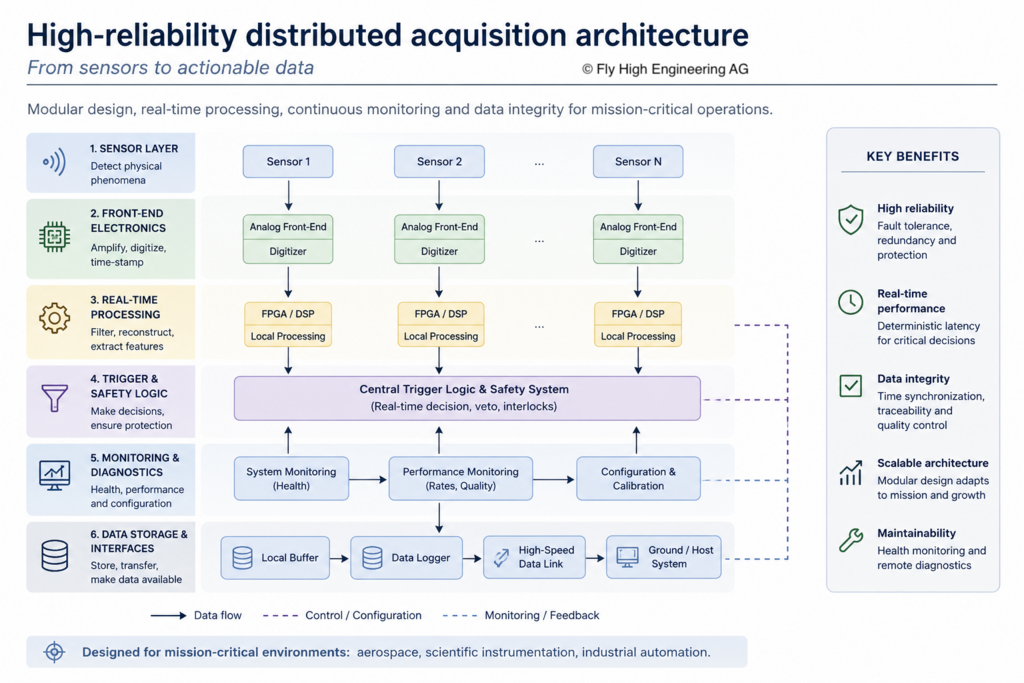
We contributed to several large experiments in space and underground involving sizable multi-national collaborations, with activities ranging from experiment design (conception, statistical inference, simulation), through system and subsystem development and commissioning (hardware and software), to statistical analysis of experimental results. We are currently developing our own safety-related avionics sensor (Pitot Guardian®) for commercial aviation.
Aerospace and scientific instrumentation projects require modular architectures, deterministic processing, continuous monitoring, and long-term operational reliability. The same engineering principles can be applied to design and modernization of industrial systems.